


- 영문명
- When Does Participative Leadership Foster Voice?: Generational Differences and the Moderating Role of Coworker Knowledge Sharing
- 발행기관
- 대한리더십학회
- 저자명
- 채희선(Heesun Chae) 이희옥(Hee Ok Lee) 정동섭(Dong Seop Chung)
- 간행물 정보
- 『리더십연구』제16권 제4호, 3~39쪽, 전체 37쪽
- 주제분류
- 경제경영 > 경영학
- 파일형태
- 발행일자
- 2025.11.30
7,240원
구매일시로부터 72시간 이내에 다운로드 가능합니다.
이 학술논문 정보는 (주)교보문고와 각 발행기관 사이에 저작물 이용 계약이 체결된 것으로, 교보문고를 통해 제공되고 있습니다.
국문 초록
본 연구는 구성원의 의견을 존중하고 참여를 장려하는 참여적 리더십이 구성원의 발언행동에 미치는 영향을 밝히고자 하였다. 특히, 리더의 메시지를 구성원이 어떻게 해석하고 수용하는지에 있어 팀 내 사회적 단서로 작용하는 동료의 지식공유, Millennials와 Gen Z 간의 세대 차이가이러한 관계에 어떤 영향을 미치는지를 분석하였다.
이를 위해 국내 다양한 산업에 종사하는 조직구성원-직속상사 317쌍의 데이터를 수집하여, 참여적 리더십이 발언행동에 미치는 영향을 동료의 지식공유와 세대를 조절변수로 포함한 조절된 조절 모형을 통해 검증하였다. 분석 결과, 참여적 리더십은 구성원의 발언행동을 촉진하며, 이관계는 동료의 지식공유 수준이 높을수록 강화되는 것으로 나타났다. 또한, 세대에 따른 차이를분석한 결과, Millennials의 경우 참여적 리더십과 발언행동 간의 관계가 더 강하게 나타났으며, Gen Z는 동료의 지식공유를 통해 리더의 메시지를 해석하는 경향이 커, 동료의 지식공유의 조절효과가 더 뚜렷하게 나타났다.
이러한 결과는 참여적 리더십의 효과가 구성원이 속한 사회적 맥락과 세대 특성에 따라 달라질 수 있음을 보여주며, 발언행동이라는 자발적 행동을 유도하기 위해 리더와 동료, 그리고 세대 간 상호작용을 고려한 정교한 리더십 전략이 필요함을 시사한다. 본 연구는 리더의 참여적 메시지가 수용되는 조건을 사회적 정보처리 관점에서 밝힘으로써 이론적⋅실무적 통찰을 제공한다.
영문 초록
This study investigates how participative leadership—characterized by respect for employee input and encouragement of involvement—influences employees’ voice behavior. Specifically, it examines how coworker knowledge sharing functions as a social cue within teams, shaping employees’ interpretation of leaders’ messages, and how this process differs across generational cohorts, namely Millennials and Generation Z.
To test these relationships, matched survey data were collected from 317 employee-supervisor dyads across various industries in South Korea. A moderated moderation model was employed to assess whether the effect of participative leadership on voice behavior varies depending on the levels of coworker knowledge sharing and generational group. The analysis revealed that participative leadership significantly promotes employee voice, and this effect is amplified when coworker knowledge sharing is high.
Furthermore, the relationship between participative leadership and voice behavior was stronger among Millennials. For Gen Z employees, the moderating effect of coworker knowledge sharing was more pronounced, suggesting that they rely more heavily on peer cues to interpret leaders’ participative messages.
These findings highlight that the effectiveness of participative leadership may differ depending on the employee’s social context and generational traits. To foster voluntary voice behavior, leaders must adopt context-sensitive leadership strategies that consider the interplay between leader behaviors, coworker signals, and generational characteristics. This study offers theoretical and practical insights by identifying the conditions under which participative leadership messages are effectively received, through the lens of social information processing theory.
목차
Ⅰ. 서 론
Ⅱ. 이론적 배경 및 가설설정
Ⅲ. 연구방법
Ⅳ. 연구결과
Ⅴ. 결론 및 논의
참고문헌
키워드
해당간행물 수록 논문
참고문헌
관련논문
경제경영 > 경영학분야 BEST
더보기경제경영 > 경영학분야 NEW
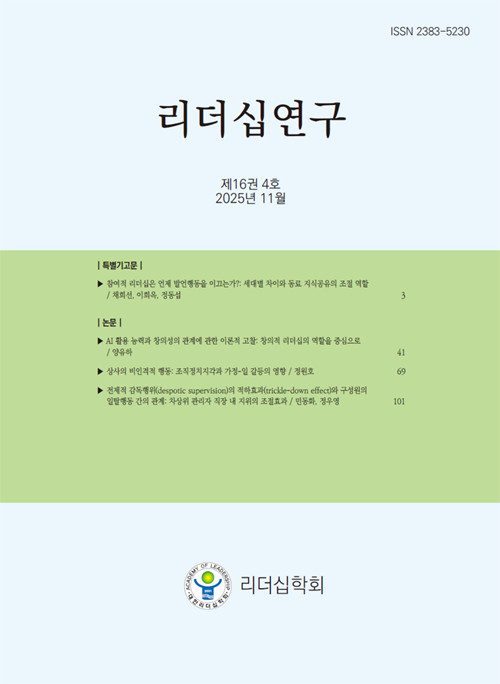
- 참여적 리더십은 언제 발언행동을 이끄는가?: 세대별 차이와 동료 지식공유의 조절 역할
- AI 활용 능력과 창의성의 관계에 관한 이론적 고찰: 창의적 리더십의 역할을 중심으로
- 상사의 비인격적 행동: 조직정치지각과 가정-일 갈등의 영향
최근 이용한 논문
교보eBook 첫 방문을 환영 합니다!

신규가입 혜택 지급이 완료 되었습니다.
바로 사용 가능한 교보e캐시 1,000원 (유효기간 7일)
지금 바로 교보eBook의 다양한 콘텐츠를 이용해 보세요!