


학술논문
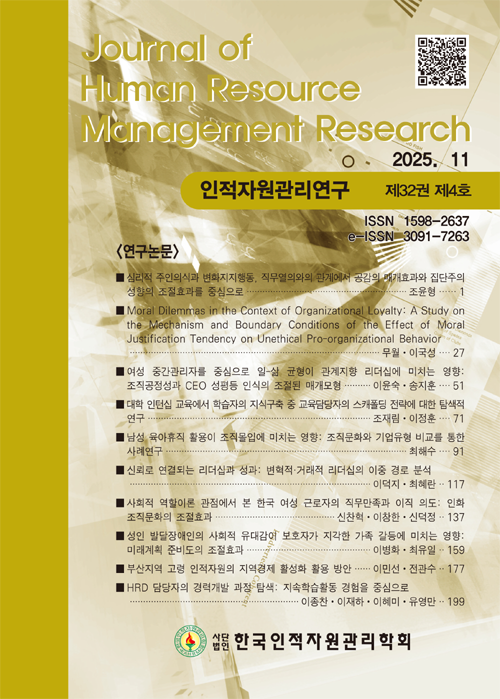
Moral Dilemmas in the Context of Organizational Loyalty: A Study on the Mechanism and Boundary Conditions of the Effect of Moral Justification Tendency on Unethical Pro-organizational Behavior
이용수 0
- 영문명
- 발행기관
- 한국인적자원관리학회
- 저자명
- Yue Wu Gukseong Lee
- 간행물 정보
- 『인적자원관리연구』제32권 제4호, 27~49쪽, 전체 23쪽
- 주제분류
- 경제경영 > 경영학
- 파일형태
- 발행일자
- 2025.11.30
국문 초록
최근 비윤리적 친조직행동(UPB)의 양상과 결정요인에 대한 관심이 지속적으로 높아지고 있다. 본 연구는 직원의 도덕 정당화 경향이 비윤리적 친조직 행동(Unethical Pro-organizational Behavior, UPB)에 미치는 영향과 그 경계 조건을 분석하였다. 자기조절이론(Self-Regulation Theory)과 사회인지이론(Social Cognitive Theory)을 바탕으로, 정서와 개인차를 포함한 조절된 매개 모형을 제시하고 검증하였다. 중국의 다양한 산업에 종사하는 514명의 기업 직원을 대상으로 설문조사를 실시하였으며, ‘문권성’ 플랫폼을 통해 자료를 수집하고 구조방정식모형(SEM)으로 분석하였다.
연구 결과는 다음과 같다. (1) 도덕 정당화 경향은 UPB를 유의하게 정(+)적으로 예측하였다. (2) 죄책감은 도덕 정당화 경향과 UPB 사이에서 부분 매개 역할을 하였다. (3) 자기모니터링 경향은 또한 죄책감을 매개로 한 도덕 정당화 경향의 UPB 간 간접효과를 조절하였으며, 이를 통해 조절된 매개 효과 가설이 검증되었다.
본 연구는 ‘인지–정서–행동’ 경로에서 도덕 정당화 과정의 양날의 검 효과를 분석하였으며, 이는 조직 상황에서 UPB가 직원 행동에 영향을 미치는 작용 메커니즘 중 하나임을 제시한다. 또한 UPB 선행 요인에 관한 이론을 보완하고, 중국 문화 맥락에서의 기업 경영 실무에 참고할 만한 시사점을 제공한다.
영문 초록
In recent years, increasing attention has been paid to the manifestations and drivers of unethical pro-organizational behavior (UPB). This study focuses on employees’ moral justification tendency (MJT) to examine its influence on UPB and the boundary conditions shaping this relationship. Drawing on self-regulation theory and social cognitive theory, we propose and empirically test a moderated mediation model that incorporates an emotional mechanism (guilt) and an individual difference factor (self-monitoring tendency). Survey data were collected from 514 employees across diverse industries in China using the Questionnaire Star platform and analyzed with structural equation modeling (SEM).
The results reveal that: (1) moral justification tendency exerts a significant positive effect on UPB; (2) guilt partially mediates the relationship between moral justification tendency and UPB; and (3) self-monitoring tendency moderates the indirect effect of moral justification tendency on UPB via guilt, thereby supporting the moderated mediation model.
By mapping a cognition-emotion-behavior pathway, this study demonstrates how moral justification tendency can operate as a double-edged sword in organizational contexts. The findings extend theoretical understanding of UPB antecedents and provide practical implications for managing employee behavior within the Chinese cultural setting.
목차
Ⅰ. Introduction
Ⅱ.Theoretical Background and Hypotheses Development
Ⅲ. Method
Ⅳ. Results
Ⅴ. Discussion
References
키워드
해당간행물 수록 논문
참고문헌
최근 이용한 논문
교보eBook 첫 방문을 환영 합니다!

신규가입 혜택 지급이 완료 되었습니다.
바로 사용 가능한 교보e캐시 1,000원 (유효기간 7일)
지금 바로 교보eBook의 다양한 콘텐츠를 이용해 보세요!