


- 영문명
- The Temporal Standard For the Application of Administrative Statutes
- 발행기관
- 전남대학교 법학연구소
- 저자명
- 이영무(Young Moo Lee)
- 간행물 정보
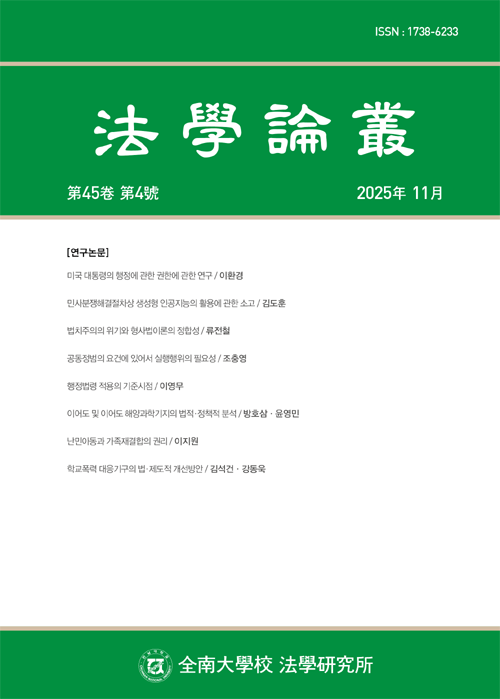
- 『법학논총』제45권 제4호, 105~134쪽, 전체 30쪽
- 주제분류
- 법학 > 법학
- 파일형태
- 발행일자
- 2025.11.30
국문 초록
행정법령은 그 성질상 사회적・경제적 여건 변화에 따라 빈번하게 개정이 이루어지는 속성을 지니고 있다. 이러한 특성에 따라 행정법령을 적용할 때 어느 시점의 법령을 적용하여야 하는지에 대한 문제가 빈번하게 대두된다.
이러한 문제는 첫째, 행정청이 행정처분을 행할 경우에 가장 많이 발생한다고 볼 수 있다. 둘째, 행정처분이 행하여진 이후에 해당 처분에 대하여 항고소송이 제기되고 법원이 그 위법성 여부의 판단을 행할 경우에도 처분시와 판결시 중 어느 시점의 법령을 기준으로 그 위법성 여부를 판단할 것인지가 문제되기도 한다.
위와 같은 행정법령 적용의 기준시점에 관하여는 그동안 법적 근거가 없어, 실무적으로 논란이 있거나 혼선을 빚고 있는 상황이 오랫동안 지속되어 왔다. 행정기본법의 제정으로 그러한 혼란 상황이 어느 정도 해소된 것은 큰 의미가 있다.
행정기본법은 처분 중에서 그 특성이 가장 두드러진다고 볼 수 있는 신청에 따른 처분과 제재처분에 대하여는 그 법령적용의 기준시점을 별도로 규정하고, 그 외 다른 처분에 대해서는 처분시주의를 원칙으로 하면서도 예외적으로 소급적용금지의 원칙을 실정화함으로써 일단 그동안의 실무상 논란과 혼선을 정리하였다고 볼 수 있다. 하지만 위 규정만으로 모든 문제가 해결된 것은 아니고 아직도 해석을 통하여 보완하여야 할 점이 적지 않다. 본 논문은 행정법령의 적용의 기준시점과 관련하여 그동안 단편적으로 존재하던 판례를 새로이 제정된 행정기본법 규정과의 관계에서 체계적으로 이해하고, 아울러 향후 해석상 문제가 될 소지가 있는 쟁점을 사전에 검토하여 보았다는 데에 그 의미가 있다.
다음으로 행정기본법 제14조가 원래는 행정청이 처분을 할 경우에 대비한 규정이라는 것은 분명하다. 하지만 신청에 따른 처분과 제재처분이 가지는 특성은 항고소송이 제기된 이후 법원이 위법성 여부를 판단할 때에도 중요한 고려요소가 될 수 있다고 보여진다. 그리하여 거부처분 취소소송에서는 그것이 실질적으로 의무이행소송과 같은 역할과 기능을 하고 있는 점에 더하여, 신청에 따른 처분이 장래의 적법한 행정질서의 유지와 형성을 주된 목적으로 하고 있다는 점을 고려하여 그 위법성 여부의 판단은 판결시를 기준으로 하는 것이 타당하다. 또한 제제처분에 대한 취소소송의 경우 원칙적으로 위반행위시의 법령을 기준으로 그 위법성 여부를 판단하여야 하는 것이 법문언에 비추어 분명하나, 제재처분 후 법령등의 변경에 의하여 그 행위가 법령등을 위반한 행위에 해당하지 아니하거나 제재처분 기준이 가벼워진 경우에는 판결시의 법령을 기준으로 그 위법성 여부를 판단하는 것이 목적론적 해석에 적합하고 아울러 문언적 해석에 비추어 보아도 무리가 없다.
영문 초록
Due to their inherent nature, administrative statutes are frequently amended in response to changing social and economic conditions. Consequently, the question of which version of statutes should be applied at a given time often arises in administrative practice.
This issue most commonly arises, first, when an administrative authority imposes an administrative disposition, and second, when a court subsequently reviews the legality of that disposition in an administrative litigation, raising the question of whether the applicable law should be determined as of the time of disposition or the time of judgment.
For a long time, there was no explicit statutory basis clarifying the temporal standard for the application of administrative statutes, resulting in persistent confusion and controversy in practice. The enactment of the General Act on Public Administration has therefore been a significant step forward, as it has provided a certain degree of legal clarity.
The Act distinguishes between dispositions made upon application and those imposing sanctions—two types of dispositions most representative of administrative action—and prescribes separate temporal standards for each. For other types of dispositions, it generally adopts the time-of-disposition principle, while codifying the principle of non-retroactivity as an exception, thereby resolving much of the previous practical uncertainty. Nevertheless, these provisions do not resolve all interpretative challenges. There remain several issues that must still be supplemented through interpretation. This article seeks to provide a systematic understanding of the previously fragmented case concerning the temporal application of administrative statutes in light of the newly enacted General Act. Furthermore, it identifies and examines potential interpretative issues that may arise in future applications.
It is clear that Article 14 of the General Act on Public Administration was originally designed to guide administrative authorities in rendering dispositions. Nevertheless, the distinctive nature of dispositions upon application and sanction dispositions also has important implications when courts review their legality in administrative litigation. In particular, in lawsuits for the cancellation of refusal dispositions, which in substance often function as actions for the performance of obligations, the legality should be assessed by the statute in effect at the time of judgment, given that such dispositions primarily aim to maintain and shape a lawful administrative order for the future. By contrast, in lawsuits seeking the cancellation of sanction dispositions, the legality should, in principle, be determined according to the statute in effect at the time of the violation, as is evident from the statutory text. Nonetheless, when the relevant legal provisions are amended after the sanction such that the act in question no longer constitutes a violation, or the applicable sanction has been mitigated, it is both teleologically sound and textually permissible to assess the legality based on the statute in effect at the time of judgment.
목차
Ⅰ. 서론
Ⅱ. 행정청이 처분을 행할 경우의 기준시점
Ⅲ. 법원이 위법성 여부를 판단하는 기준시점
Ⅳ. 결론
참고문헌
키워드
해당간행물 수록 논문
참고문헌
최근 이용한 논문
교보eBook 첫 방문을 환영 합니다!

신규가입 혜택 지급이 완료 되었습니다.
바로 사용 가능한 교보e캐시 1,000원 (유효기간 7일)
지금 바로 교보eBook의 다양한 콘텐츠를 이용해 보세요!