


- 영문명
- Necessity of action in the requirements of a joint criminal offense
- 발행기관
- 전남대학교 법학연구소
- 저자명
- 조충영(Chung-Young Jo)
- 간행물 정보
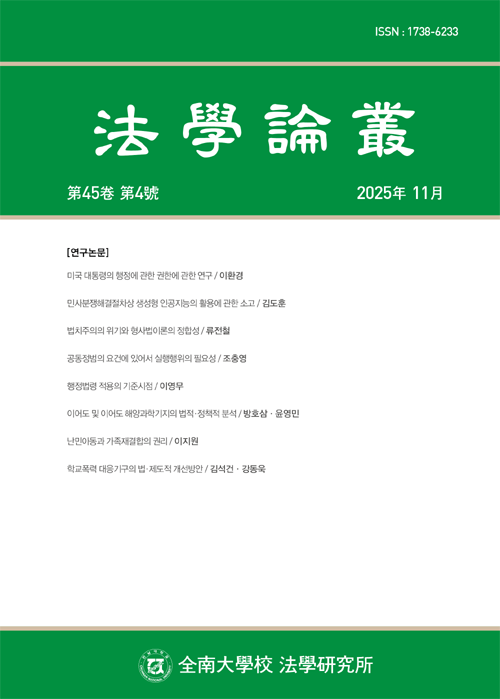
- 『법학논총』제45권 제4호, 85~104쪽, 전체 20쪽
- 주제분류
- 법학 > 법학
- 파일형태
- 발행일자
- 2025.11.30
국문 초록
형법 제30조의 공동정범은 ‘2인 이상이 공동하여 죄를 범한 때에는 각자를 그 죄의 정한 형으로 처벌한다’고 규정하고 있다. 이 규정의 해석과 관련하여서는 공동정범 각자에게 그 범죄가 필요로 하는 구성요건적 행위, 즉 객관적 요소가 필요한가, 아니면 전체에게 구성요건 행위만 있으면 충분하고 각 가담자 별로 객관적인 행위는 필요로 하지 않고 공모만으로도 공동정범이 될 수 있는가에 대하여 많은 논쟁이 있어 왔다. 대법원은 시간이 지나면서 그 논증 방법에 여러 변화가 있었지만 결론은 일관되게 실행행위를 분담하지 않고 공모에만 참여하여도 공동정범이 성립될 수 있다는 입장을 취하고 있다. 그러나 공모만으로 공동정범이 성립할 수 있다는 이러한 해석은 형법의 가장 기본원칙인 죄형법정주의 그 중 명확성의 원칙에 반한다. 대법원이 ‘본질적 기여’나 ‘기능적 행위지배’라는 용어를 사용하여 공모에만 가담하여도 공동정범이 될 수 있다는 것에 어느 정도 제약을 가하려고 하였지만 결론은 결국 공모만으로도 공동정범이 성립한다는 것인데 이는 범죄행위에 어느 정도의 가담이 있어야만 공동정범이 성립하는지에 대한 기준을 제대로 제시하지 못하여 일반상식을 가진 수범자에게 예측가능성을 전혀 담보해 주지 못한다. 게다가 정범과 공범을 구별하지 않는 단일범죄체계라면 몰라도 정범과 공범을 구별하는 이원적 체계를 취하고 있는 우리 형사법 체계에서 공모를 정범의 표지로 내세우게 되면 구성요건을 직접 실현하지 않는 교사와 방조와의 경계가 허물어지게 된다. 나아가 조직범죄에서 그 배후에 있는 간부나 두목을 처벌하기 위하여 등장한 공모공동정범이지만 이러한 개념을 인정하지 않더라도 형법이나 형사특별법의 규정으로 형사법 체계내에서 충분히 대처가 가능하기에 지금은 법정책적으로 이를 인정하여야 할 필요성도 거의 없다. 공범규정이나 범죄단체에 관한 형사법의 규정으로 조직에 가입・활동하는 자를 처벌할 수 있을 뿐만 아니라 배후의 수괴나 간부에 대하여는 정범보다도 더 중하게 처벌할 수도 있기 때문이다. 게다가 범죄단체에 관한 형사법의 규정은 범죄를 행하지 않아도 이를 목적으로 구성되면 처벌이 가능하도록까지 규정되어 있어 예방적 기능도 있다. 이렇게 본다면, 공모공동정범은 이론적으로나 법정책적으로 인정할 필요가 전혀 없다고 생각한다.
영문 초록
The joint criminal under Article 30 of the Criminal Code stipulates that “if two or more people commit a crime jointly, each person shall be punished as a fixed punishment for the crime.” Regarding the interpretation of this regulation, there has been much debate about whether each joint criminal needs a constituent act, that is, an objective element, or whether it is sufficient to have a constituent act for the whole and can become a joint criminal only by conspiracy without requiring an objective act for each participant. The Supreme Court has changed its method of argument over time, but the conclusion is consistently taking the position that a joint criminal can be established by participating in the conspiracy alone without sharing the action of execution. However, this interpretation that a joint criminal can be established only by public offering is contrary to the most basic principle of the criminal law, the principle of clarity among the criminal courtism. The Supreme Court tried to impose some restrictions on the possibility of becoming a joint criminal even if they only participate in the conspiracy using the terms “essential contribution” or “functional behavior domination,” but the conclusion is that a joint criminal can be established only by the conspiracy, which does not guarantee any predictability to a criminal with general common sense because it does not properly present the criteria for how much participation in a criminal act is established. Moreover, even if it is a single criminal system that does not distinguish between regular offenders and accomplices, if public offering is presented as a cover for regular offenders in our criminal law system, which has a dual system that distinguishes between regular offenders and accomplices, the boundary between teachers and assistance who do not directly realize the constituent requirements will be broken. Furthermore, although it is a co-conspiracy criminal who emerged to punish the executives or leaders behind organized crime, even if this concept is not recognized, it is now possible to sufficiently cope with the criminal law system under the provisions of the Criminal Law or Special Criminal Law, so there is little need to admit it in a legal policy. This is because the provisions of the Criminal Law on accomplice regulations or criminal organizations not only can punish those who join or operate an organization, but also punish the gangsters or executives behind them more seriously than regular offenders. Moreover, the provisions of the Criminal Law on Criminal Organizations have a preventive function as they are even stipulated so that punishment is possible if they are constructed for this purpose without committing a crime. In this way, I don't think there is a need to recognize co-conspiracy criminals theoretically or legally.
목차
Ⅰ. 들어가며
Ⅱ. 공모공동정범에 관한 학설 및 판례의 내용
Ⅲ. 공모공동정범 긍정설 및 판례에 대한 비판적 검토
Ⅳ. 나가며
참고문헌
키워드
해당간행물 수록 논문
참고문헌
최근 이용한 논문
교보eBook 첫 방문을 환영 합니다!

신규가입 혜택 지급이 완료 되었습니다.
바로 사용 가능한 교보e캐시 1,000원 (유효기간 7일)
지금 바로 교보eBook의 다양한 콘텐츠를 이용해 보세요!