


- 영문명
- From Work-Life Balance to Relationship-Oriented Leadership - A Moderated Mediation via Organizational Justice Conditional on CEO Gender-Equality Orientation
- 발행기관
- 한국인적자원관리학회
- 저자명
- 이윤숙(Yun Sook Lee) 송지훈(Ji hoon Song)
- 간행물 정보
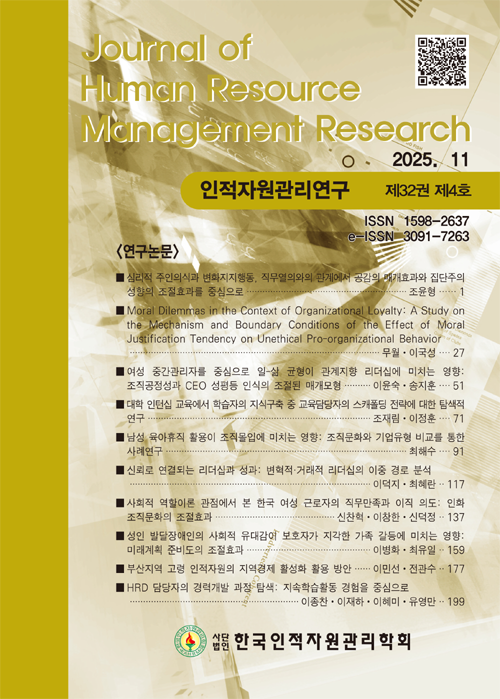
- 『인적자원관리연구』제32권 제4호, 51~69쪽, 전체 19쪽
- 주제분류
- 경제경영 > 경영학
- 파일형태
- 발행일자
- 2025.11.30
5,080원
구매일시로부터 72시간 이내에 다운로드 가능합니다.
이 학술논문 정보는 (주)교보문고와 각 발행기관 사이에 저작물 이용 계약이 체결된 것으로, 교보문고를 통해 제공되고 있습니다.
국문 초록
본 연구의 목적은 국내 여성 중간관리자를 대상으로 일-삶 균형과 관계지향 리더십의 관계에서 주요한 전제가 되는 조직공정성과 그 사이에서 조절 영향을 주는 CEO의 성평등인식에 대해 검증하는 것에 있다. 이에 본 연구는 국내 100인 이상 기업에 종사하는 여성 중간관리자 3.076명을 대상으로, 일-삶 균형(WLB)이 관계지향 리더십에 미치는 영향을 조직공정성 매개와 최고경영자(CEO) 성평등인식의 조절된 매개 효과를 통해서 규명하였다. 데이터는 여성관리자패널 3차년도 자료를 활용하였고, PROCESS Macro(Model 14)로 조절된 매개모형을 추정하였다. 신뢰구간 추정을 위해 부트스트래핑5,000회와 Johnson–Neyman 기법을 병행하였다. 첫째, WLB는 관계지향 리더십에 유의한 정(+)의 직접효과를 보였다. 둘째, 조직공정성의 단순 매개효과는 통계적으로 유의하지 않았다. 셋째, CEO 성평등 인식은‘조직공정성 → 관계지향 리더십’경로를 유의하게 조절하였으며, CEO 성평등 인식이 낮은 조건에서는 효과가 약화(또는 부적)되고 높은 조건에서는 강화되는 양상이 확인되었다. 조절된 매개효과 지수는 유의하였다. 이러한 결과는 WLB가 제공하는 심리·인지적 자원이 조직공정성 만으로는 자동적으로 리더십 행동으로 전이되지 않으며, 최고경영진의 성평등 가치와 톤-앳-더-탑(Tone at the top)의 신호가 존재할 때 공정성이 관계지향 리더십으로 연결됨을 시사한다. 이러한 결과를 종합하여 이론 및 실무적 시사점, 한계점과 후속연구의 방향에 대해 논의하였다.
영문 초록
This study investigates how work-life balance (WLB) among women middle managers relates to relationship-oriented leadership, focusing on the mediating role of organizational justice and the moderating role of the chief executive officer’s (CEO’s) gender-equality orientation. The analysis tests whether justice functions as a key precondition for translating personal resources from WLB into relational leadership behaviors, and whether signals from the top—reflecting the CEO’s commitment to gender equality—shape this translation.
Survey data from 3,076 women middle managers employed in Korean firms with 100 or more employees were analyzed, using the third-year wave of the Women Manager Panel. WLB, organizational justice, relationship-oriented leadership, and perceived CEO gender-equality orientation were measured with multi-item scales. A moderated mediation model was estimated with the PROCESS Macro (Model 14). To obtain interval estimates, bootstrapping with 5,000 resamples was applied, and the Johnson-Neyman technique was used to identify regions of significance for the moderator.
Results showed three main findings. First, WLB had a significant positive direct effect on relationship-oriented leadership. Women managers reporting better balance also reported greater engagement in listening, empathy, support, and trust-building behaviors. Second, the simple mediating effect of organizational justice was not statistically significant, indicating that justice alone did not automatically carry the effect of WLB into relationship-oriented leadership across the full sample. Third, the CEO’s gender-equality orientation significantly moderated the “organizational justice → relationship-oriented leadership” path. When perceived CEO orientation toward gender equality was low, the justice-leadership link weakened and could even turn negative; when perceived CEO orientation was high, the link strengthened, and the indirect effect of WLB on leadership through justice became reliably positive. Consistent with these patterns, the index of moderated mediation was significant, indicating that the size of the indirect effect varied as a function of the CEO’s gender-equality orientation.
Taken together, the findings suggest that the psychological and cognitive resources supported by WLB do not, by themselves, guarantee more relationship-oriented leadership. Rather, the conversion of justice perceptions into relational behavior depends on clear signals from the top. A visible “tone at the top” endorsing gender equality appears to authorize and reinforce the enactment of supportive, relational leadership among women middle managers.
The study provides several implications. For theory, the model integrates individual resources (WLB), organizational cognitions (justice), and senior-leadership signals into a single conditional process, clarifying when and how WLB translates into leadership behavior. For practice, two levers appear most effective in combination: (a) job and policy designs that protect WLB (e.g., predictable workloads, autonomy in scheduling, and recovery time) and (b) consistent CEO-level signaling and systems that promote gender equality, which help justice perceptions “travel” into daily leadership actions. Limitations and directions for future research include multi-wave designs, behavioral measures, and broader tests across industries and leadership levels.
목차
Ⅰ. 서 론
Ⅱ. 이론적 배경 및 연구가설
Ⅲ. 연구방법
Ⅳ. 연구결과
Ⅴ. 결론 및 토의
참고문헌
키워드
해당간행물 수록 논문
- 인적자원관리연구 제32권 제4호 목차
- 사회적 역할이론 관점에서 본 한국 여성 근로자의 직무만족과 이직 의도: 인화 조직문화의 조절효과
- 대학 인턴십 교육에서 학습자의 지식구축 중 교육담당자의 스캐폴딩 전략에 대한 탐색적 연구
- 남성 육아휴직 활용이 조직몰입에 미치는 영향 - 조직문화와 기업유형 비교를 통한 사례연구
- 신뢰로 연결되는 리더십과 성과: 변혁적·거래적 리더십의 이중 경로 분석
- 부산지역 고령 인적자원의 지역경제 활성화 활용 방안
- 성인 발달장애인의 사회적 유대감이 보호자가 지각한 가족 갈등에 미치는 영향 - 미래계획 준비도의 조절효과
- HRD 담당자의 경력개발 과정 탐색: 지속학습활동 경험을 중심으로
- 심리적 주인의식과 변화지지행동, 직무열의와의 관계에서 공감의 매개효과와 집단주의 성향의 조절효과를 중심으로
- Moral Dilemmas in the Context of Organizational Loyalty: A Study on the Mechanism and Boundary Conditions of the Effect of Moral Justification Tendency on Unethical Pro-organizational Behavior
- 여성 중간관리자를 중심으로 일-삶 균형이 관계지향 리더십에 미치는 영향 - 조직공정성과 CEO 성평등 인식의 조절된 매개모형
참고문헌
교보eBook 첫 방문을 환영 합니다!

신규가입 혜택 지급이 완료 되었습니다.
바로 사용 가능한 교보e캐시 1,000원 (유효기간 7일)
지금 바로 교보eBook의 다양한 콘텐츠를 이용해 보세요!